
Intermediate workshop
AI-Assisted Development Foundations
Master the principles behind AI code generation and build a context ecosystem that works with any AI coding assistant.
Learn more
GitHub Copilot AI Credits: The Billing Change Developers Should NOT Ignore
Developers had barely gotten comfortable with premium requests when GitHub changed the rules again.
As of June 1, 2026, Copilot uses AI Credits for many paid AI features. The name sounds harmless. The model behind it changes how teams should think about Copilot usage.
Existing annual individual plans may have a legacy transition path, but the direction is clear: Copilot is moving from request counting to usage-based billing.
The old pricing model counted requests. The new model prices model work.
That difference becomes visible once Copilot stops acting like autocomplete and starts acting like an agent. A quick chat question, a PR review, and a repository-level refactor do not put the same load on the system. GitHub now ties those interactions to model usage instead of treating them as equal requests.
For developers who mostly use inline suggestions, the change may stay in the background. For teams using Copilot Chat, agents, code review, Spaces, Spark, or third-party coding agents, AI Credits become part of the operating cost.
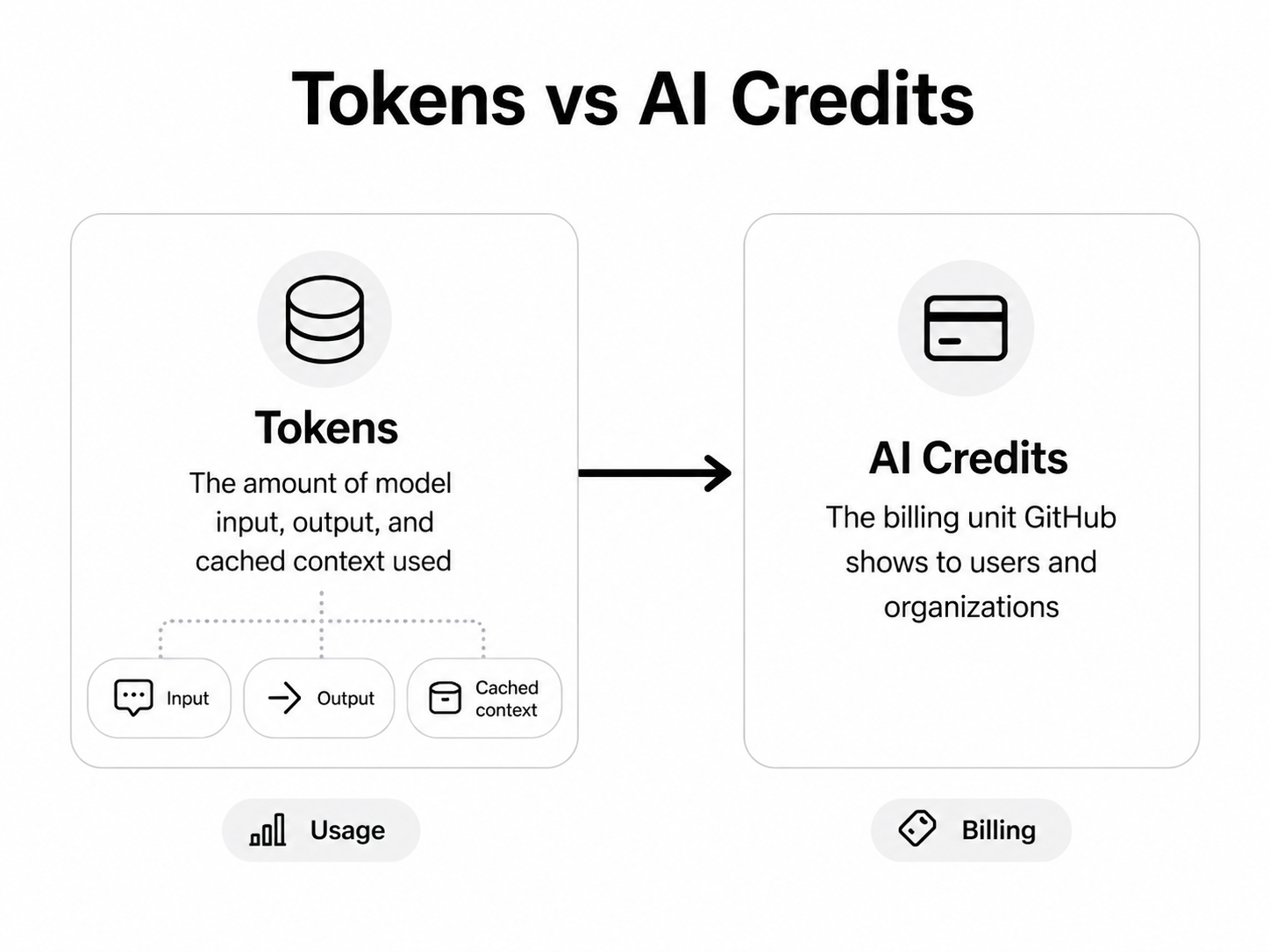
Copilot still runs on tokens.
Tokens cover the text you send, the text the model returns, and cached context the model stores or reuses. A small prompt may use a small number of tokens. A long agent session over a large codebase may use many more.
GitHub converts that token usage into AI Credits.
1 AI Credit = $0.01 USD
So the model works in tokens. Your billing dashboard speaks in credits.
A practical way to read it:
The model choice matters too. More capable models cost more per token. A lightweight chat answer and a frontier-model agent session will not hit your allowance the same way.
Before June 2026, Copilot used a premium-request model. GitHub counted requests, then applied multipliers depending on the model.
The new billing model uses two inputs:
the model used;
the tokens consumed.
That gives GitHub a cleaner way to price heavier workflows. It also gives teams a more honest view of how much AI work they are using.
A one-line explanation in chat and an agent analyzing several files no longer belong in the same mental bucket. The second one asks Copilot to read more, reason more, and generate more. The bill now reflects that.
Paid Copilot plans now include a monthly AI Credit allowance, while Business and Enterprise plans pool credits across the organization instead of treating every developer as a separate quota.
I would not memorize the exact numbers. The useful takeaway is simpler: autocomplete stays mostly invisible, but chat, agents, and automated reviews now consume a budget.
Inline completions and next edit suggestions remain outside AI Credit billing for paid plans.
That is the key detail for many developers. If you mostly use Copilot for autocomplete in the IDE, this update may not change your daily flow.
AI Credits apply to features that use more model work, including:
Copilot Chat;
Copilot CLI;
Copilot cloud agent;
Copilot Spaces;
Spark;
third-party coding agents.
Copilot Code Review has an extra twist. It consumes AI Credits for model usage and GitHub Actions minutes for the workflow infrastructure.
So if your team starts using automated reviews at scale, you need to watch both sides of the cost.
GitHub did not invent this pattern. If AI Credits feel familiar, that is probably because the whole market is moving in the same direction: AI features are becoming usage-based products, and providers are adjusting their pricing around how people actually consume them.
AI products keep moving toward credits, usage tiers, message limits, and bundled allowances because raw token accounting is too low-level for most users. Developers may understand tokens. Finance teams, procurement teams, and engineering managers usually want a cleaner budget unit.
You can see similar patterns across the tooling market:
Cursor packages usage through fast requests and plan allowances.
Claude Pro and Claude Max use tiers and message limits, while the API still exposes token pricing.
Perplexity Pro gives users a fixed amount of advanced searches and premium model usage.
Replit uses credits across AI and cloud resources.
The product shape differs, but the direction is the same. AI work costs money because it consumes compute. Vendors need a unit that hides some of the model-level complexity while still letting them meter expensive workflows.
For coding tools, that pressure increases once agents enter the picture.
Agents read files, call tools, inspect context, revise output, and sometimes loop through the same task several times. A request counter cannot describe that cost well. Credits do a better job, even if they add one more number for developers to track.
Treat Copilot as two products.
The first product is classic Copilot: inline suggestions, small completions, and quick edits. That still feels like an IDE feature.
The second product is agentic Copilot: chat over large context, code review, repository analysis, multi-file changes, and cloud agent sessions. That behaves more like infrastructure, and infrastructure gets measured.
That means engineering teams need a few new habits:
check usage before rolling agents out across a whole team;
choose models intentionally for large tasks;
set budgets before experimenting at scale;
separate casual chat usage from migration or review workflows;
watch automated review costs if GitHub Actions minutes already matter in your setup.
Nobody needs to count every credit during normal work. But teams that already track CI minutes, cloud spend, or API usage should treat AI usage the same way.
GitHub Copilot’s June 2026 pricing change moves Copilot from request counting to usage-based billing.
That matches the direction of the product. Copilot is no longer only an autocomplete tool. It now runs chats, agents, reviews, repository analysis, and multi-step workflows.
Inline completions stay largely unchanged for paid users. Heavier workflows now draw from an AI Credit allowance based on model and token usage - and that is the real shift.
Autocomplete still feels like a feature in the editor. Agents behave more like compute.
Once you see it that way, AI Credits make more sense. They are not just a new billing label. They are GitHub’s way of pricing the work Copilot now does beyond autocomplete.
Intermediate workshop
Master the principles behind AI code generation and build a context ecosystem that works with any AI coding assistant.
Learn more
AI agents don’t fail because they can’t write code. They fail because they lack architectural memory. Learn how intent-driven wikis and MCP tools create a “second brain” that helps AI make reliable engineering decisions at scale.


The dominant picture of Agentic UI is wrong. You imagine a Copilot-style chat panel grafted onto an existing product: a sidebar that takes natural language, calls a model, and prints a reply. You ship it, call it agentic, and move on.

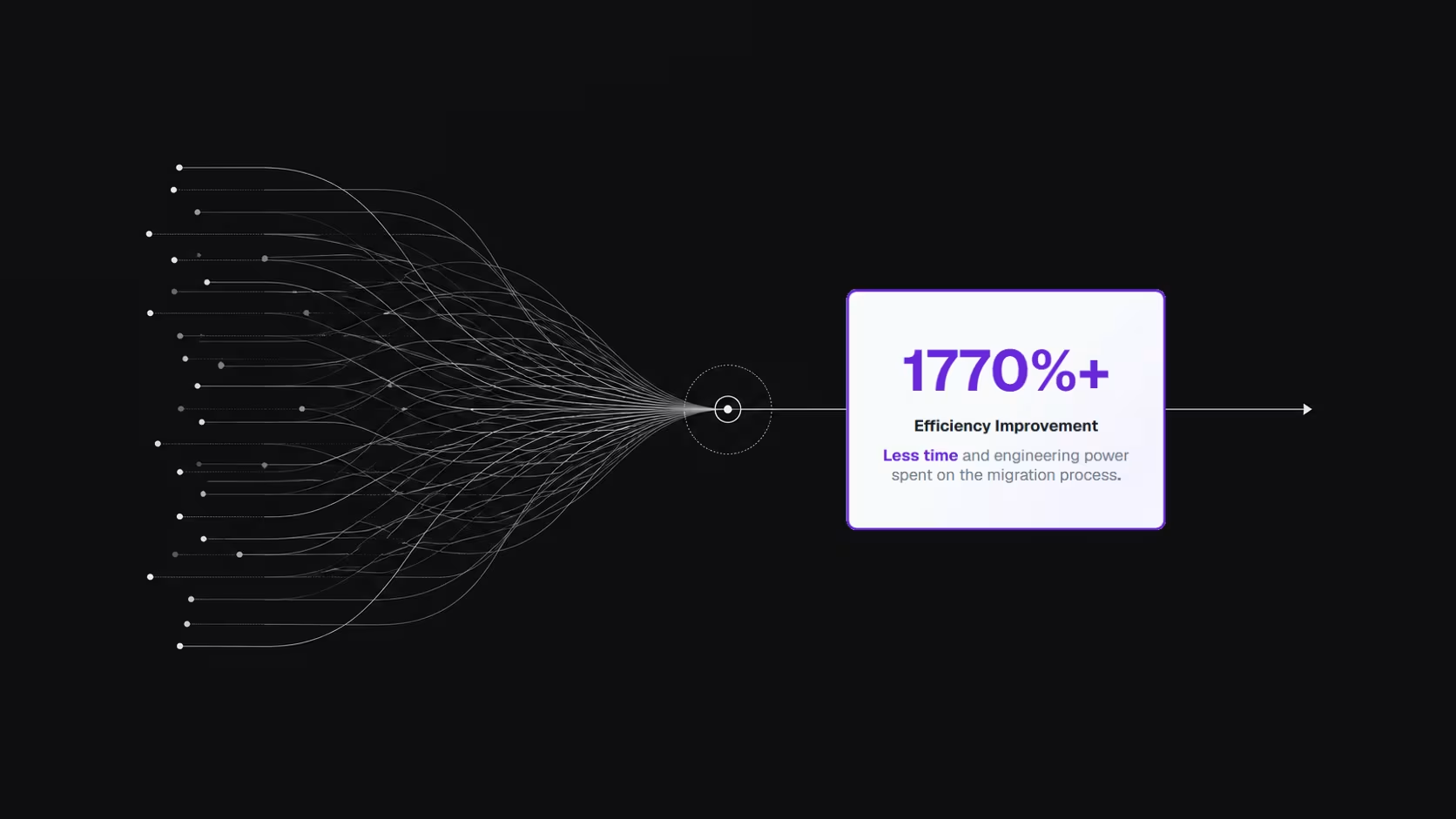
Executing design system migrations in large codebases is often cumbersome and slow - component updates, testing coordination, and knowledge management consuming thousands of man-days.