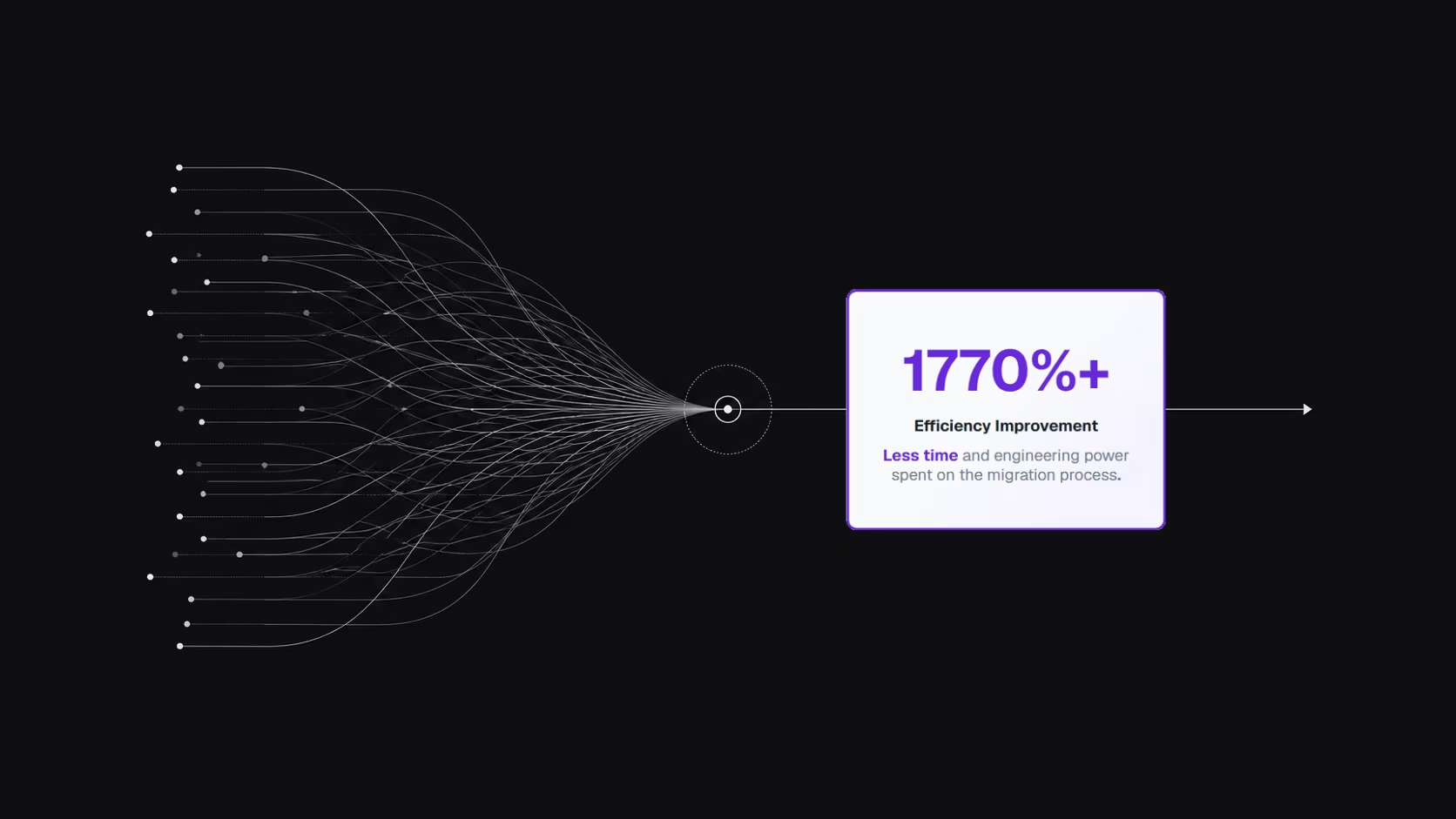
One of our enterprise clients was losing two minutes to every commit. A large JavaScript monorepo, a sizable engineering organization, and a pre-commit pipeline running formatting, linting, dependency validation, and architectural checks before code could reach the repository. At scale, inefficiencies inside frequently executed workflows compound into significant productivity costs, and this sat at the very front of the commit-to-production pipeline, repeated across every engineer, every commit, all day. We rebuilt the client's Git hook architecture and brought that wait down to seven seconds, a 16x improvement, close to a 1,500 percent gain in speed.
The Challenge
In large monorepos, Git hooks act as a critical quality gate, ensuring formatting, linting, dependency validation, and architectural checks executed before code reaches the repository. However, these safeguards can become a productivity bottleneck when the underlying tooling introduces unnecessary overhead.
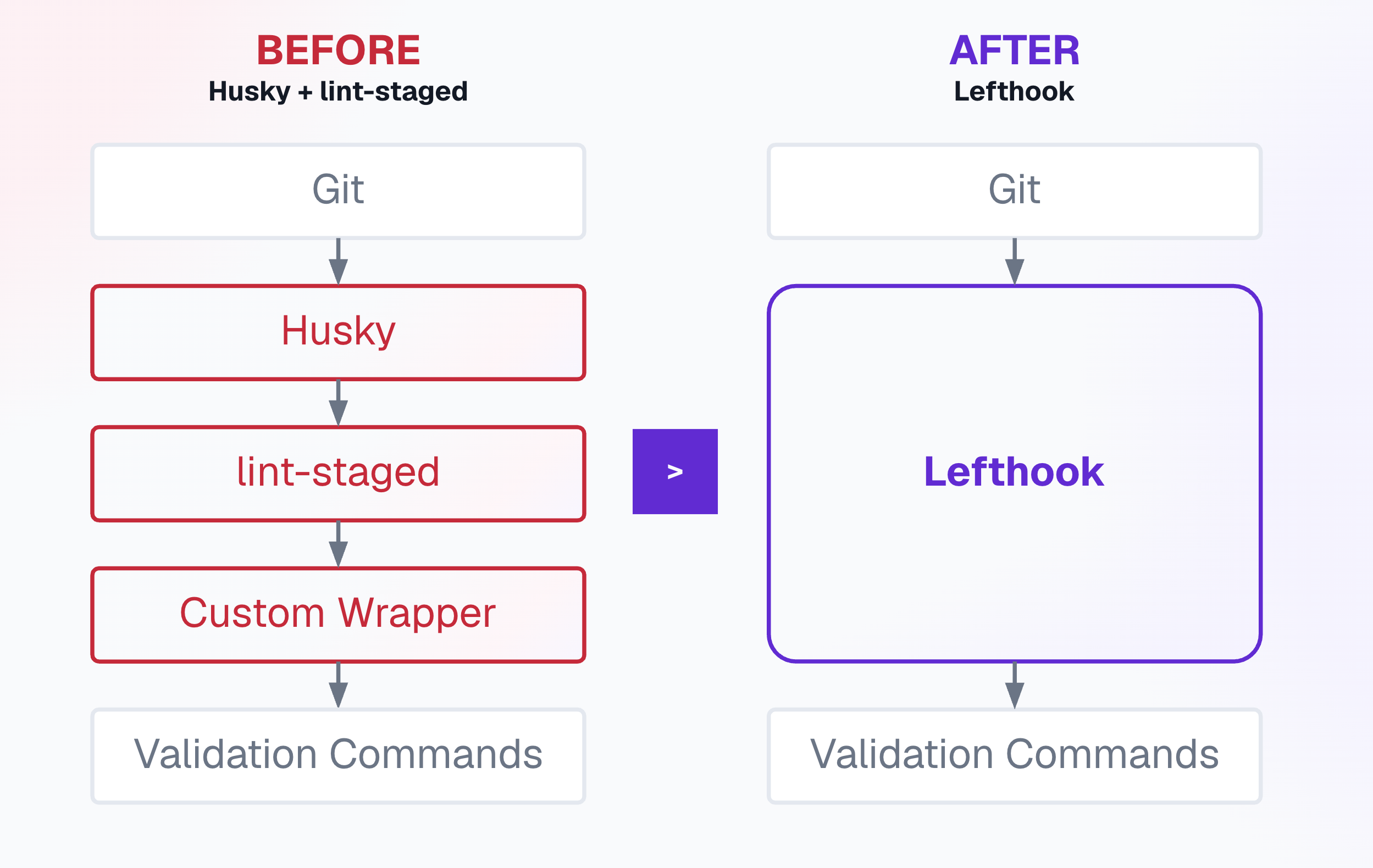
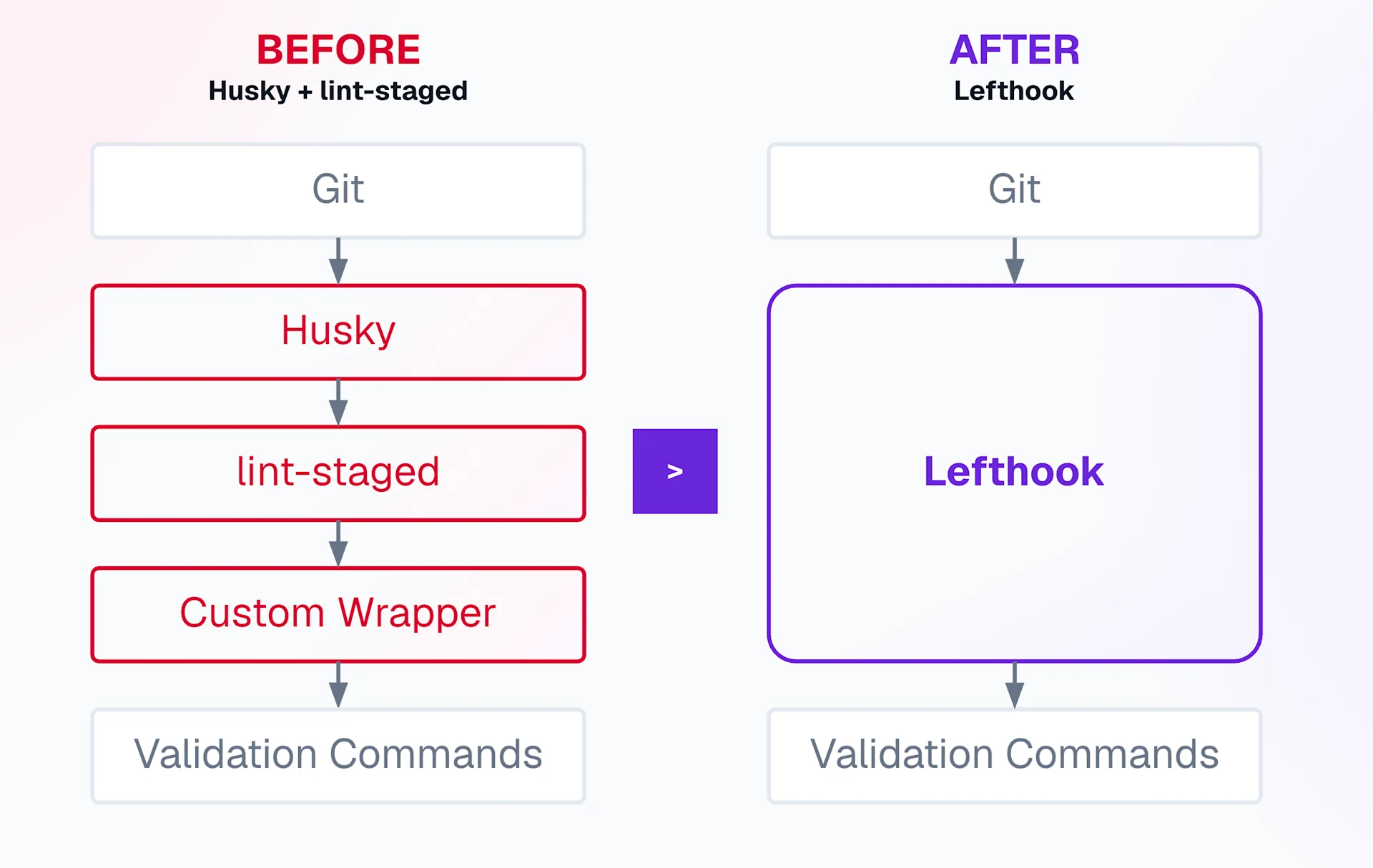
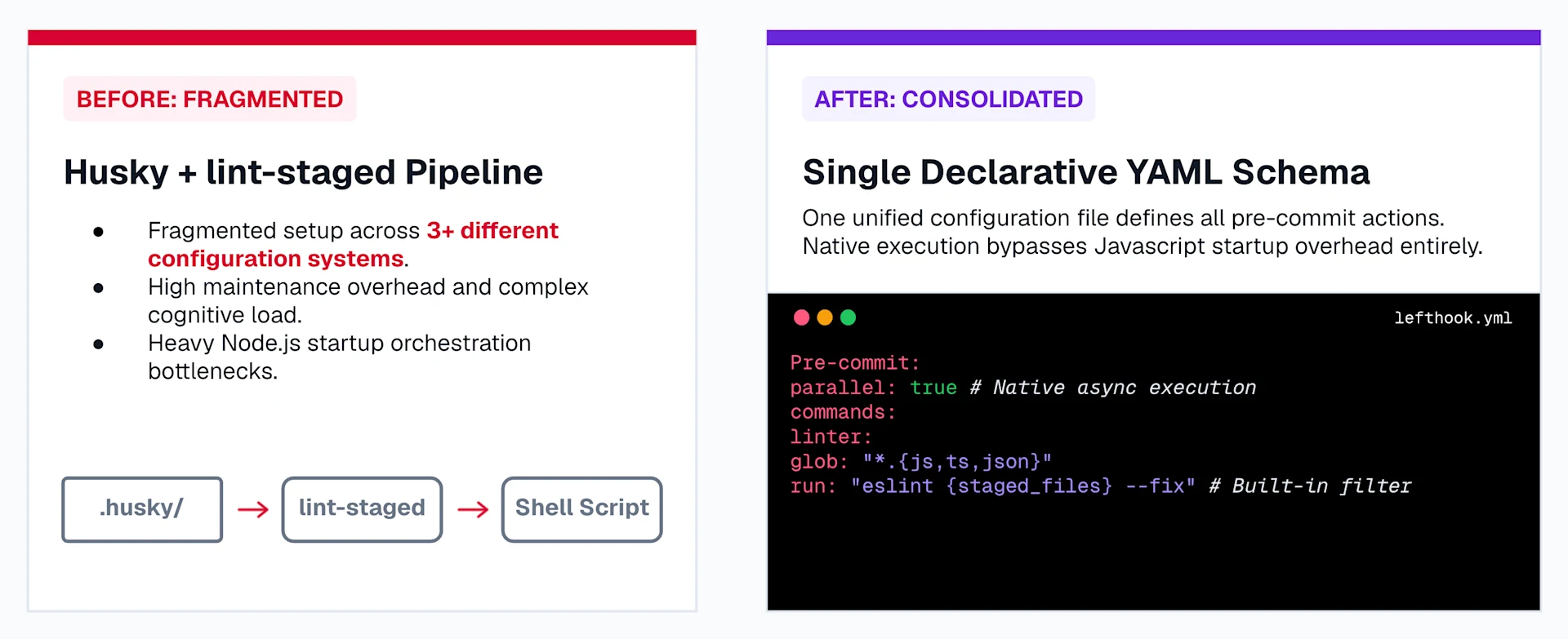
Like many enterprise JavaScript monorepos, our hook execution pipeline evolved organically. While each step is individually small, the cumulative cost becomes substantial in large repositories.
Git invokes Husky
Husky starts a Node.js process
lint-staged discovers staged files
Custom wrappers transform the arguments
Validation commands are finally executed
Measuring the Baseline
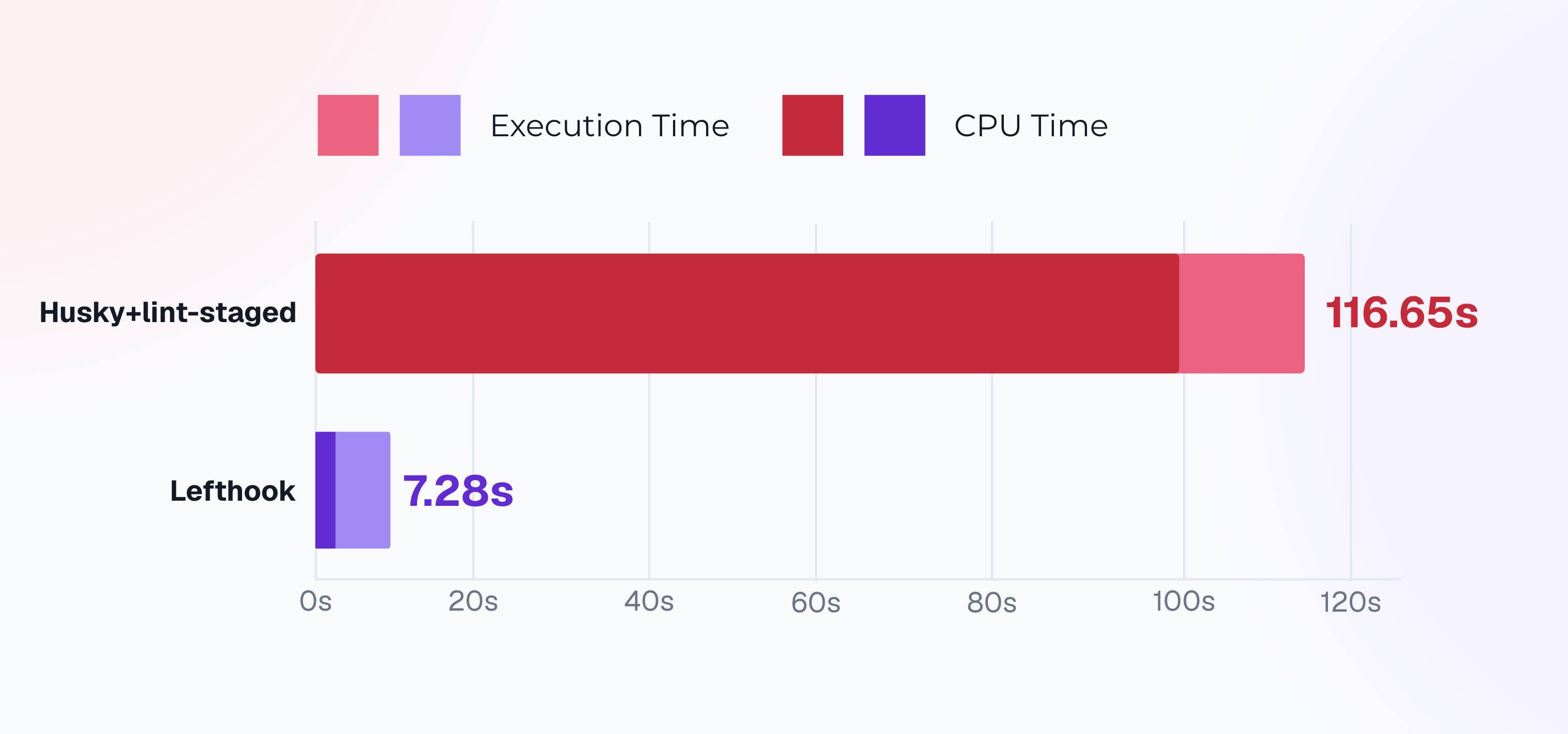
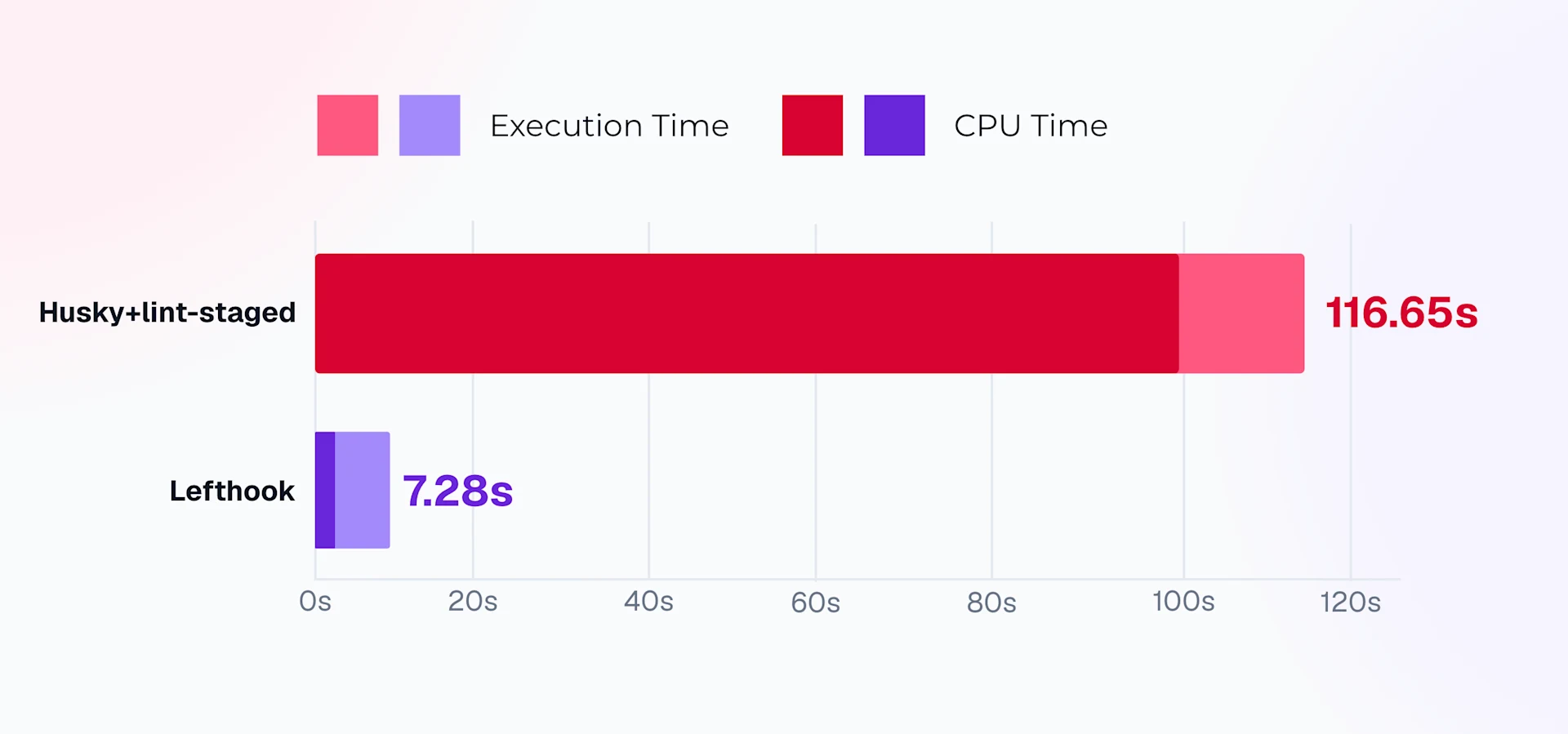
Before introducing any changes, we established performance baselines using identical staged changes.
Why lefthook
Lefthook provides several characteristics that align with our goals.
🚀 Native Binary
Unlike Husky and lint-staged, Lefthook is implemented in Go and distributed as a native executable.
Benefits
No Node.js startup overhead
No runtime dependency graph
No additional orchestration layer
🔽 Native Staged File Filtering
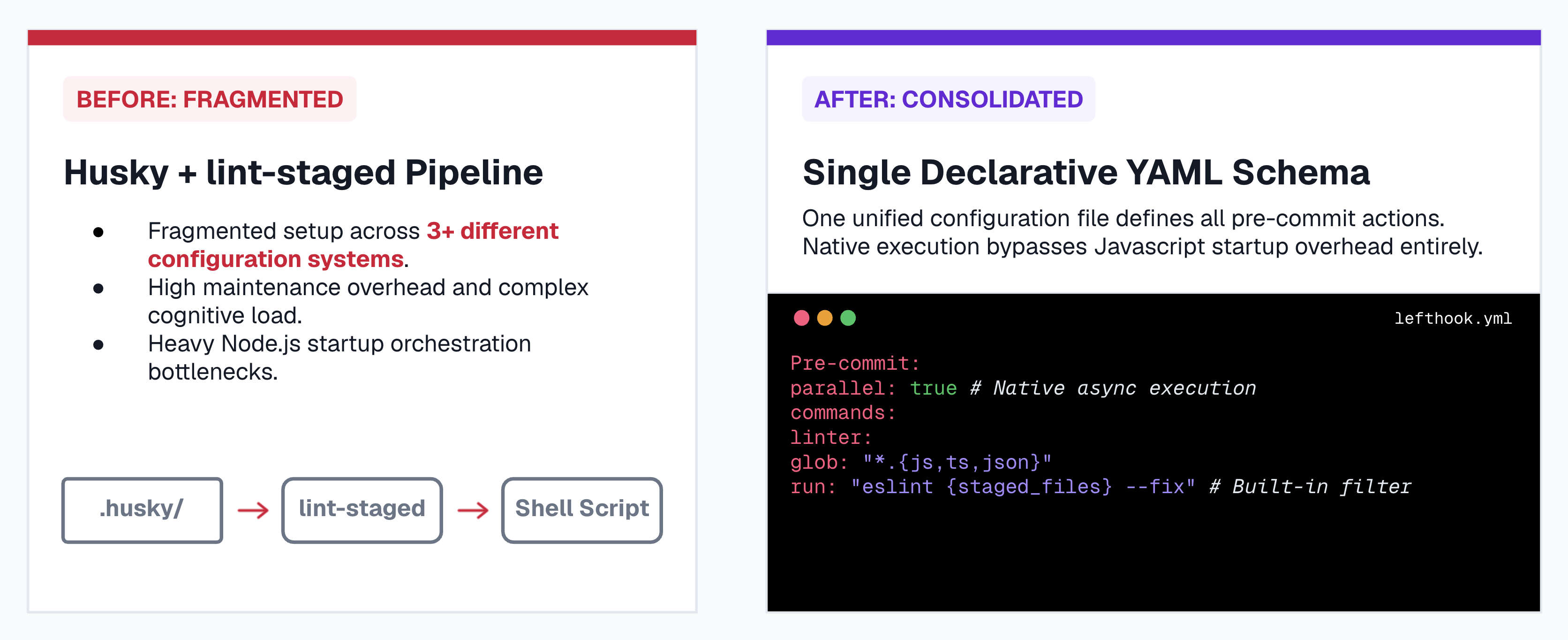
lint-staged existed primarily to solve one problem - determine which staged files should be passed to which commands.
Lefthook solves this natively, no custom JavaScript required:
glob: "*.md"
run: markdownlint-cli2 {staged_files}
⚡ Parallel Execution
Independent commands execute concurrently.
Migration Strategy
Rather than redesigning the workflow, we focused on removing orchestration layers while preserving behavior.
Results
Metric | Before | After | Improvement |
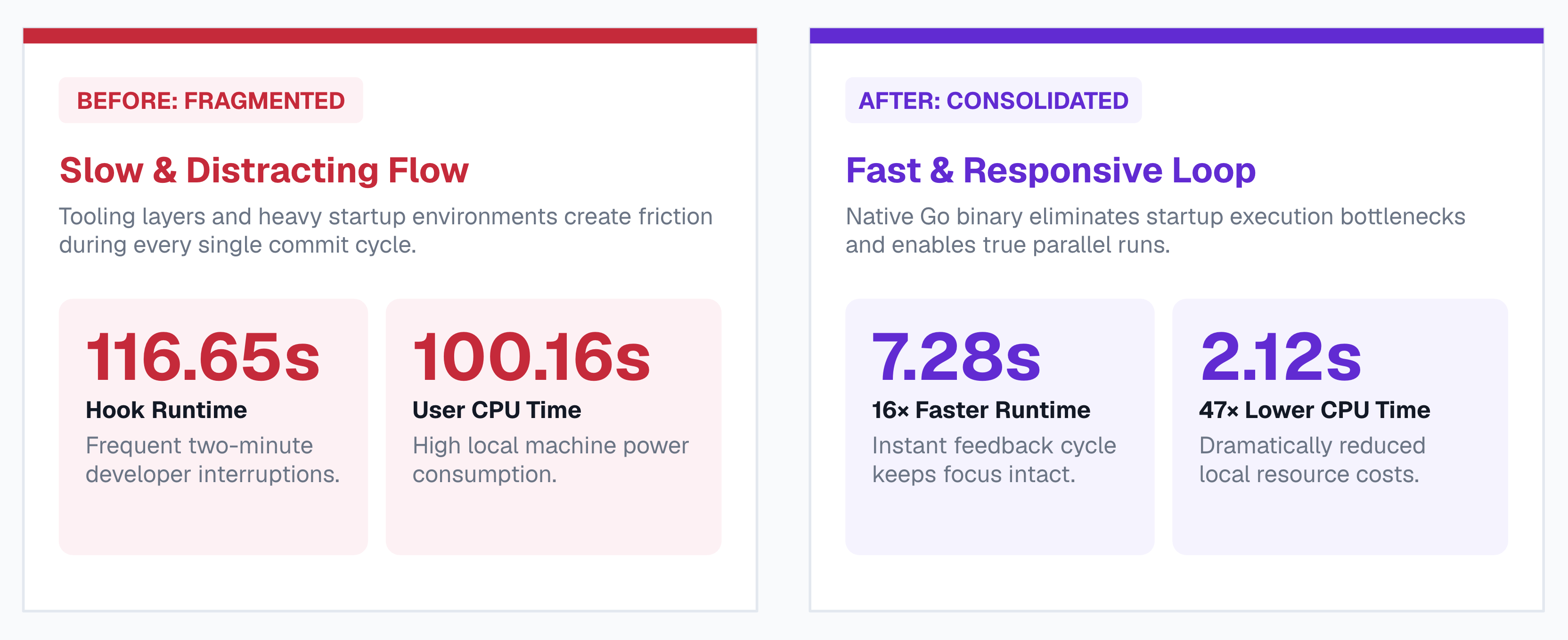
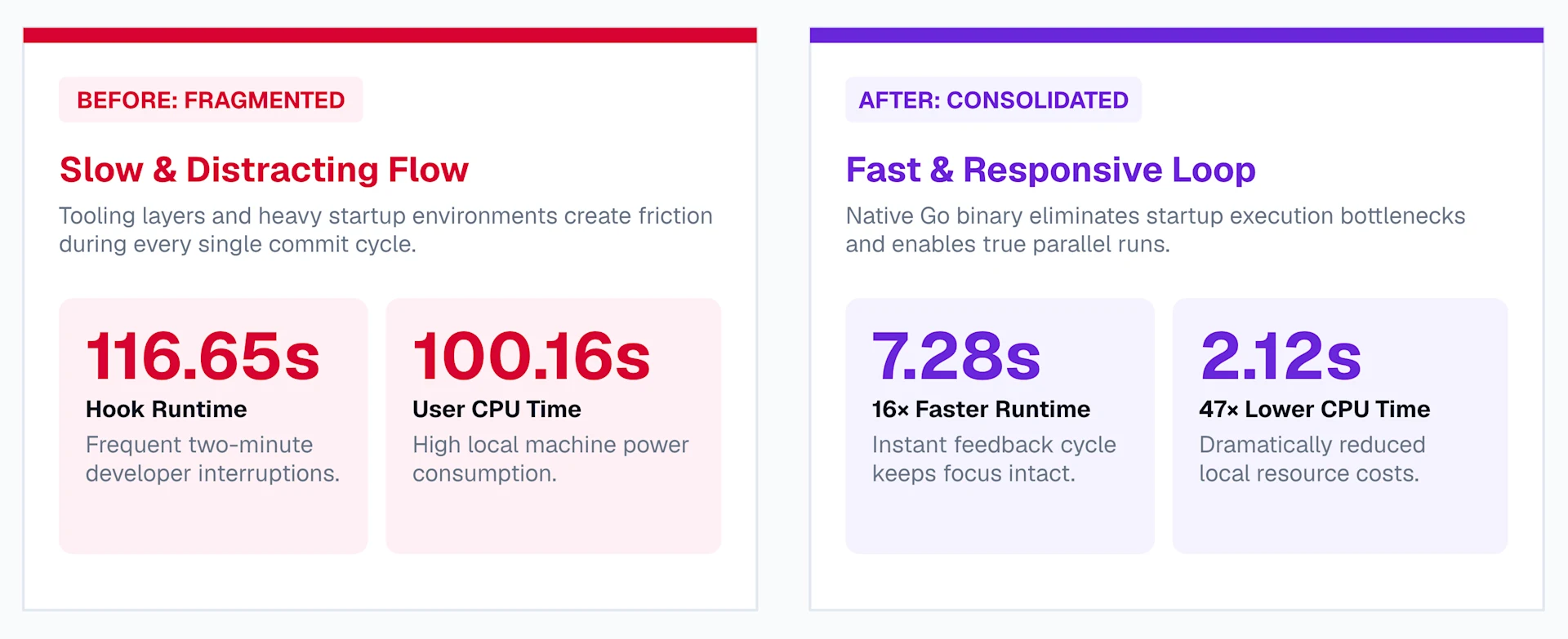
Hook runtime | 116.65s | 7.28s | 16× faster |
User CPU time | 100.16s | 2.12s | 47× lower |
System CPU time | 27.82s | 12.55s | 2× lower |
CPU utilization | 109% | 201% | 84% parallelism |
Configuration consolidation
The entire Git hook system now exists in a single configuration file, which improved discoverability, maintainability, onboarding, reviewability.
Developer Experience Impact
The performance gain becomes more meaningful when viewed through the lens of daily development.
Key Lessons
Measure Before Optimizing
The magnitude of the improvement only became visible because baseline measurements were collected before migration.
Orchestration Has a Cost
Modern development tooling often accumulates multiple orchestration layers that provide convenience but consume substantial resources.
Simplicity Scales Better
Replacing three configuration systems with a single declarative file reduced both maintenance burden and cognitive load.
For frequently executed developer workflows, startup costs become significant.
Native tooling can dramatically improve feedback loops.
Final Results
This migration was originally motivated by simplification.
The primary goal was to remove redundant tooling and consolidate configuration.
Instead, the initiative delivered a measurable productivity improvement:
16× faster hook execution
47× lower CPU consumption
True parallel execution
Simplified architecture
Reduced dependency surface
Improved developer experience
The result demonstrates that developer tooling is not merely an implementation detail.
At scale, even small inefficiencies inside frequently executed workflows compound into significant productivity costs.
By replacing Husky and lint-staged with Lefthook, we transformed a two-minute interruption into a seven-second feedback loop while simultaneously reducing complexity across the repository.
Faster feedback loops create better developer experiences. Better developer experiences create better products.