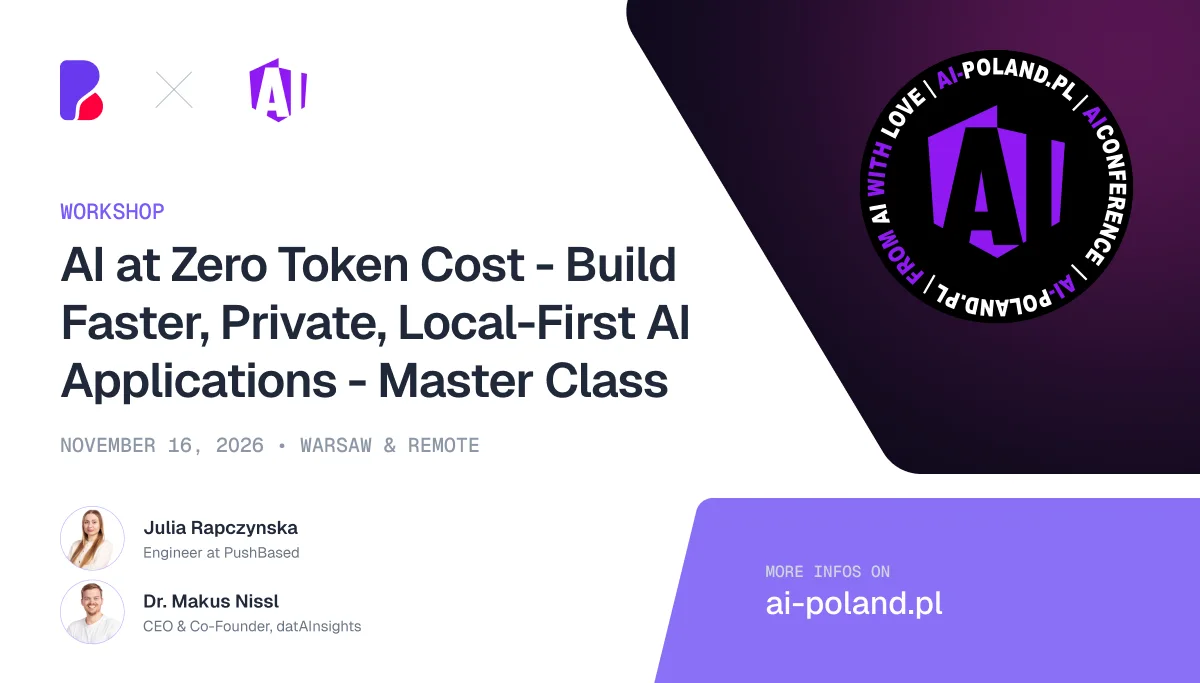
AI at Zero Token Cost - Build Faster, Private, Local-First AI Applications - Master Class | Julia Rapczynska & Markus Nissl @ AI Poland
About the event
About this workshop
AI is moving into the browser, and that changes the economics of AI-powered applications.
With browser-native AI APIs, tasks such as prompting, summarization, writing, translation, and proofreading can run directly on the user's device. This can reduce cloud inference costs, API dependencies, data transfer, and token usage, potentially to zero for supported workloads.
Combined with MCP and WebMCP, applications can expose structured tools and actions directly to AI agents without relying on expensive, context-heavy DOM automation.
In this hands-on workshop, you will learn how to build local-first, agent-ready web applications designed around one goal: do more AI work in the browser, send less to the cloud, and minimize token costs.
High-Level Workshop Agenda
Block 1: The AI-Native Browser
From Cloud AI to Browser AI
Tokens, context windows, latency, and API costs
What changes when inference moves into the browser?
Local-first, cloud-first, and hybrid AI architectures
Privacy, latency, offline capabilities, and cost
Browser Built-in AI
Understanding the browser-native AI architecture
Models, capabilities, and feature detection
Downloading and initializing browser models
Capability detection and progressive enhancement
Coffee Break
Block 2: Prompt API
Interact with the browser's built-in language model
Create and manage sessions
Use system prompts and initial prompts
Stream responses
Generate structured output
Manage context windows
Explore multimodal possibilities
Lunch Break
Block 3: Task-Specific Browser AI APIs
Discover why specialized APIs can be preferable to generic prompting.
Summarizer API
Summarize documents, articles, and application content
Configure summary types, formats, and lengths
Stream generated summaries
Summarize large documents with small context windows
Coffee Break
Block 4: Model Context Protocol and WebMCP
Model Context Protocol (MCP)
Understand why agents need tools instead of prompts alone
Work with resources, tools, and structured interfaces
Understand MCP clients and servers
Connect applications and developer tooling to AI agents
Explore where MCP fits into modern web architectures
WebMCP
Bring agent-accessible tools directly into web applications
Understand how WebMCP differs from traditional MCP
Expose application functionality to browser agents
Use declarative WebMCP with HTML forms
Use imperative WebMCP with JavaScript parameters
Q&A Session
Meet the trainers

Julia Rapczynska
 Architecture Expert
 Trainer
 Performance Expert

Markus Nissl
- Architecture Expert
- Trainer
- Performance Expert
Keep exploring
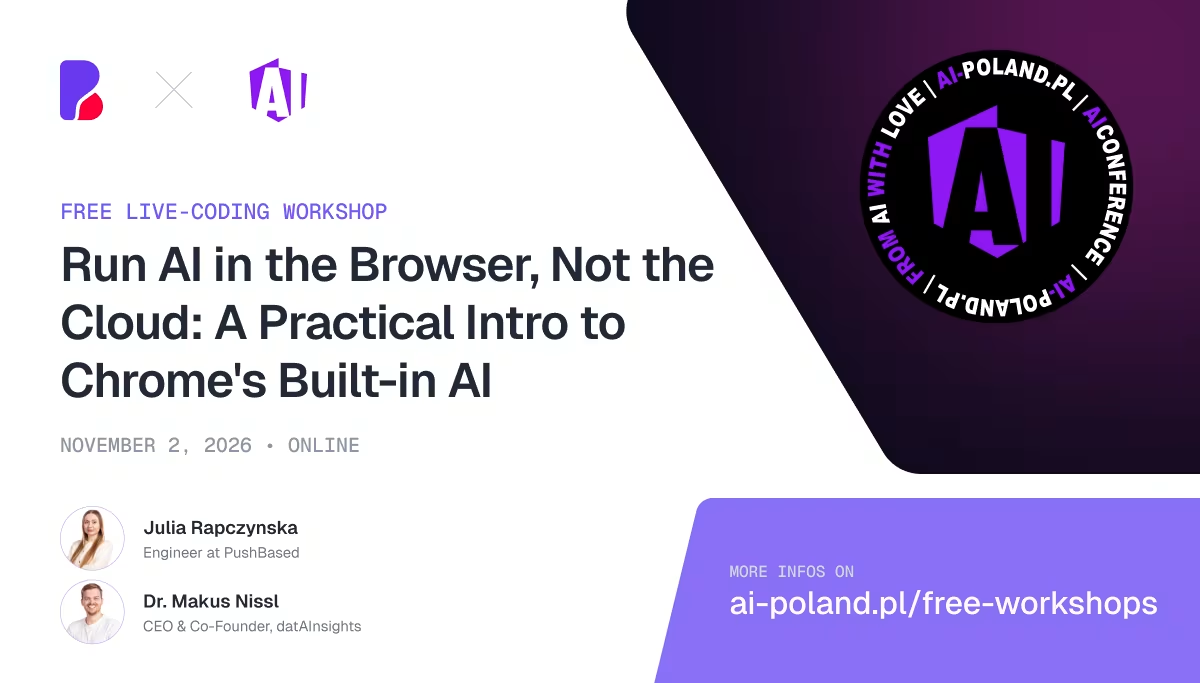
Run AI in the Browser, Not the Cloud: A Practical Intro to Chrome's Built-in AI | Free Webinar | Julia Rapczynska & Markus Nissl @ AI-Poland
AI Poland
Nov 2, 2026 · Online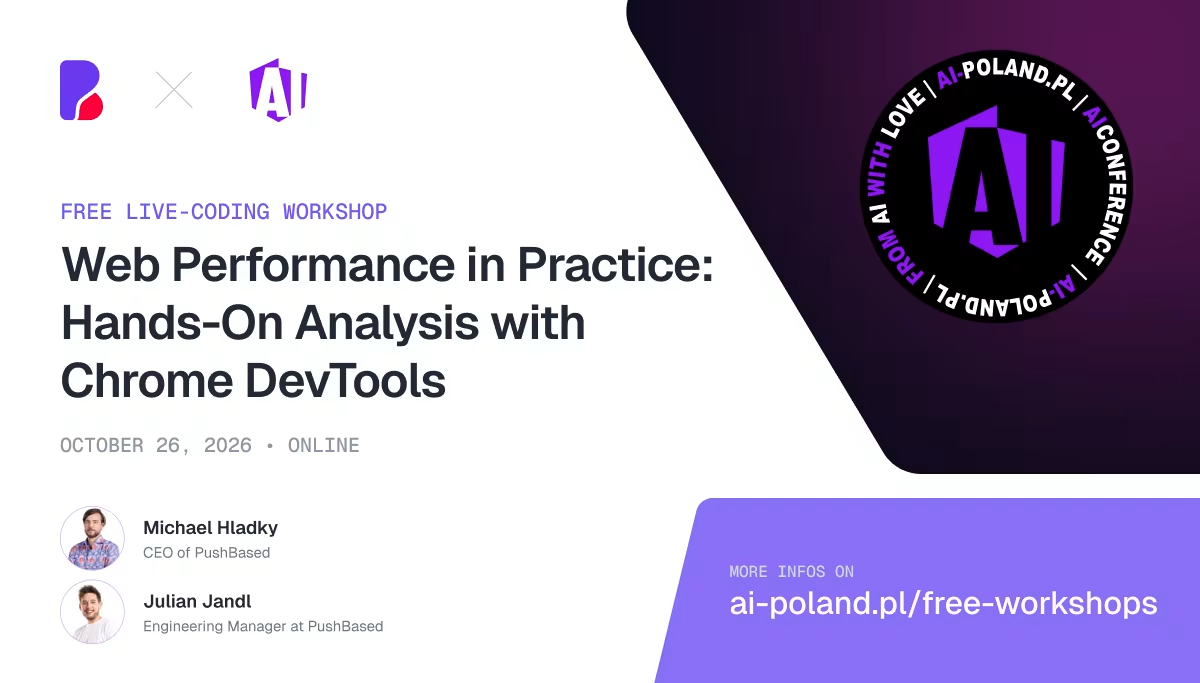
Web Performance in Practice: Hands-On Analysis with Chrome DevTools | Free Webinar | Michael Hladky & Julian Jandl @ AI-Poland
AI Poland
Oct 26, 2026 · Online
High-Speed Web Applications - Master Class | Michael Hladky & Julian Jandl @ AI Poland
AI Poland
Nov 16, 2026 · Warsaw & Online
Browser-Native AI: Stop Paying for Tokens | Michael Hladky @ AI Poland