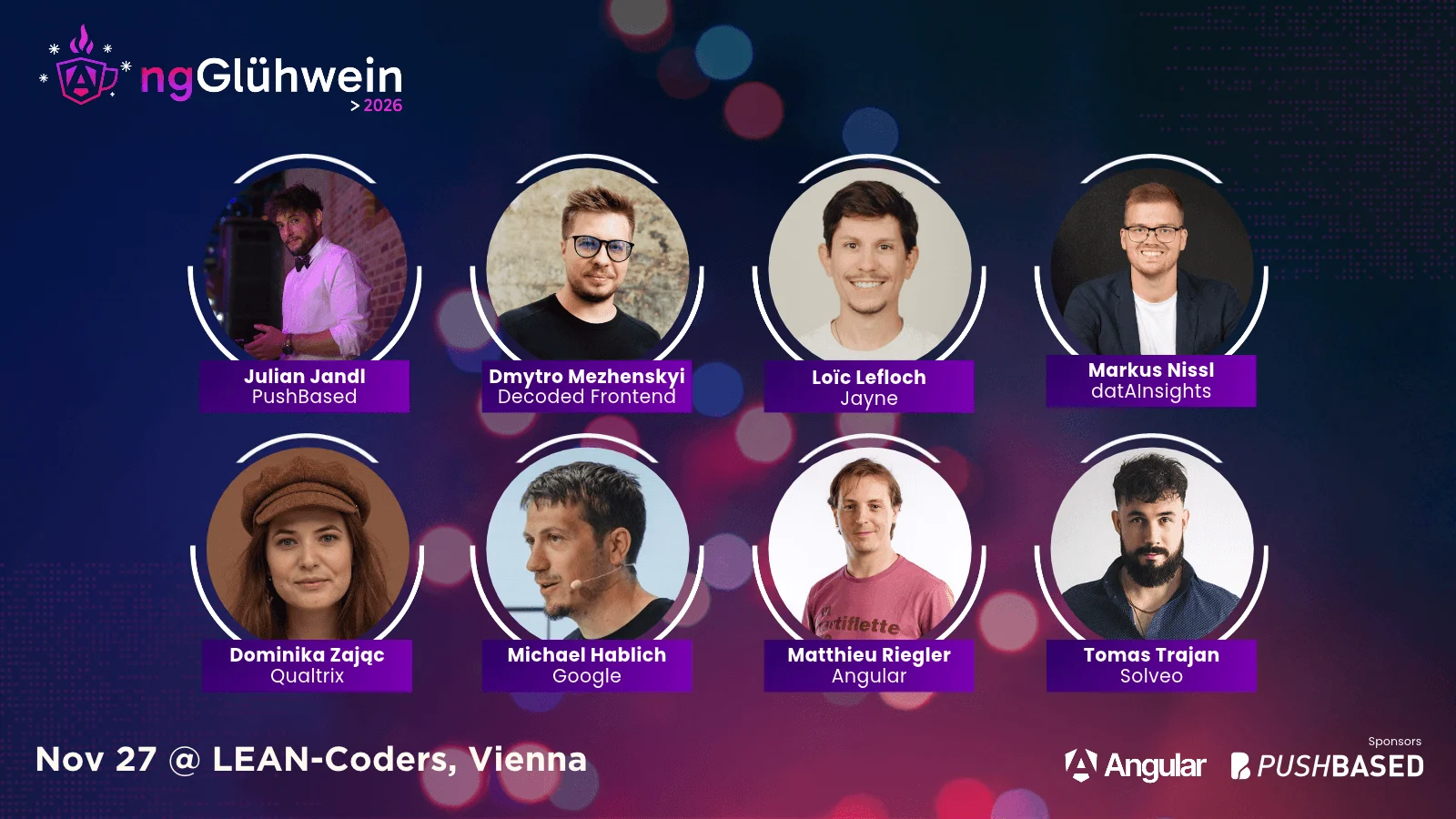
NgGlühwein 2026 - Angular Vienna's Yearly Xmas Conf
About the event
🎉 Save the Date for NgGlühwein 2026 🎉
NgGlühwein, the Angular Vienna community’s Christmas event, returns on November 27, at LEAN-Coders in Vienna. ✨
What's on the agenda:
🗣️ International Top Speakers
🎓 Knowledge sharing
🎫 Raffles of cool prices
👥 Meet old and new friends from the community
🍻 Free drinks
🍕 Free food
🎉 Open-end
Location: LEAN-Coders, Hainburger Straße 33, 1030 Vienna
------------------ 🎤🎤🎤 Line-up 🎤🎤🎤 ------------------
10:30 - 10:40 - Julia Rapczynska
Welcome & Intro
10:40 - 11:20 - Julian Jandl
Angular SSR for 40 Million Sessions a Day - Dynamic Incremental Static Regeneration
11:20 - 11:30 - Break
11:30 - 12:10 - Dmytro Mezhenskyi
Incremental Migration to Signal Forms without Big Bang
12:10 - 12:40 Coffee Break
12:40 - 13:20 - Markus Nissl
AI-Driven Interfaces: Beyond the Chat Box - Twelve patterns for the new grammar of interaction
13:20 - 13:30 - Break
13:30 - 14:10 - Dominika Zając
AI, please stop guessing a.k.a. Chrome DevTools MCP
14:10 - 15:10 - Lunch Break
15:10 - 15:50 - Loïc Lefloch
AI Factory: From customer call to changelog
15:50 - 16:00 - Break
16:00 - 16:40 - Michael Hablich
What gets measured gets optimized: evaluating the tools and skills your agents use
16:40 - 17:10 - Coffee Break
17:10 - 17:50 - Matthieu Riegler
The Impact of AI on Open Source Teams: Lessons from Angular
17:50 - 18:00 - Break
18:00 - 18:40 - Tomas Trajan
99% Less Coding, More Engineering: Agentic Angular at Enterprise Scale
18:40 - 19:00 - Raffle & Closing
19:00 - 20:00 - Hangout
------------------ 🗣️🗣️🗣️ Speakers 🗣️🗣️🗣️ ------------------
Dominika Zając (Qualtrix | LinkedIn)
AI, please stop guessing a.k.a. Chrome DevTools MCP
We used to think coding was the most difficult part of an engineer’s job. Almost every engineer I know enjoys sharing tales of spending hours debugging, wrestling with stubborn syntax, or churning out countless lines of code to meet a deadline. However, our field has changed drastically in recent months.
Coding is no longer the main challenge. With AI tools like Cursor, Copilot, or ChatGPT, generating code is fast — sometimes too fast. The true bottleneck has shifted elsewhere: to understanding what the application is actually doing, reviewing code, and debugging code generated by AI agents.
Let’s be honest: most of us aren’t working on shiny, clean greenfield demos. We work on real systems used by millions of people. We can’t simply rewrite the entire system overnight, our documentation is rarely perfect, and sometimes we have to maintain that one module built a decade ago. There is always something more pressing on the roadmap than finally replacing legacy components.
This fact remains unchanged by AI: programmers spend significantly more time reading, extending, and fixing existing code than they do generating brand new code. Can AI assist with this, too? Yes, but…
Tomas Trajan (Solveo | LinkedIn)
99% Less Coding, More Engineering: Agentic Angular at Enterprise Scale
Since April 2026, I've reduced the amount of Angular code I write manually by ~99%. So why hasn't everything collapsed into AI slop?
In this talk, I'll share my experience with agentic Angular engineering at enterprise scale, what makes it work, and how it fundamentally changes the way we build software.
Less coding, more engineering. And a glimpse into what comes next.
Dmytro Mezhenskyi (DecodedFrontend | LinkedIn)
Incremental Migration to Signal Forms without Big Bang
Migrating simple reactive or template-driven forms to Signal Forms is often straightforward. You simply rewrite them. Done. Enterprise applications, however, usually contain large, business-critical forms with complex validation, custom controls, and constantly evolving requirements. Rewriting such forms in one go can introduce significant risk and block ongoing feature development.
In this talk, Dmytro will present different techniques that enable an incremental migration strategy, helping you migrate complex forms piece by piece while keeping them functional, testable, and open to continuous feature development until the transition to Signal Forms is complete.
Julian Jandl (PushBased | LinkedIn)
Angular SSR for 40 Million Sessions a Day - Dynamic Incremental Static Regeneration
Julian shares how the PushBased team introduced server-side rendering to a mature Angular platform serving 40 million sessions a day. Their Live-Data ISR architecture keeps cached HTML fresh as betting data changes and falls back to the existing client-rendered app on a cache miss. That safety net helped the team roll out SSR across 40 brands with zero player-facing incidents and cut p75 Largest Contentful Paint from roughly 10.5 seconds to 2.7 seconds on the devices that needed it most.
He also covers what broke at scale, from Node.js memory leaks and hydration failures to connection bottlenecks in a 100-pod render farm. He’ll show how his team used shared SSR rules to guide an AI-assisted migration package by package and catch violations in code review. You’ll leave with a practical model for rolling out SSR safely and keeping it healthy through weekly releases.
Markus Nissl (datAInsights | LinkedIn)
AI-Driven Interfaces: Beyond the Chat Box - Twelve patterns for the new grammar of interaction
Chat is a brilliant default and a terrible ceiling. AI systems no longer wait for us: they perceive, predict and act, and the interfaces we've been building for decades weren't designed for that. This talk introduces twelve UI patterns for AI-driven products, built around four questions every user asks: Can I trust this? How far can it go without me? Does it learn from me? What did it do? For each pattern we look at where it already ships today and what it takes to build it yourself.
Michael Hablich (Google - ChromeDevTools, Puppeteer | LinkedIn)
What gets measured gets optimized: evaluating the tools and skills your agents use
Everyone is shipping tools and skills for agents, but almost nobody can tell you whether theirs actually help. 'It felt better in the demo' is not a metric, and with agents it is often wrong: something can look great in one transcript and quietly fail much of the time in aggregate. This deep dive shows how to put real numbers on the effectiveness and efficiency of agent-facing tools and skills. The order matters: effectiveness first, efficiency second, because saving cost is worthless if the agent never reaches the goal. Using real evaluation infrastructure as the worked example, I will cover how to run controlled with-and-without experiments scored against explicit checks, how to read the results to decide where to invest, an honest case where adding guidance made things worse, and the efficiency levers, and their trade-offs, that bring cost down once quality holds. You leave able to design an evaluation for your own agent tools instead of trusting a good-looking demo.
Matthieu Riegler (Angular | LinkedIn)
The Impact of AI on Open Source Teams: Lessons from Angular
AI is changing how we build software, and open source teams are no exception. In this talk, I’ll share what I’ve learned while experiencing this shift firsthand on the Angular team. We’ll explore how AI affects day-to-day development, team collaboration, code reviews, and technical decision-making.
Loïc Lefloch (Jayne | LinkedIn)
AI Factory: From customer call to changelog
AI made writing code cheap, but it didn’t make shipping software cheap. At Jayne, every time AI removed one bottleneck, the next one appeared: first reviewing the flood of pull requests, then knowing what the business actually needed, and finally deciding what was worth building at all.
So instead of working on the line, we built the factory. It’s an in-house tool that takes a feature from a customer call transcript to a per-customer changelog. The flow is defined in code, not in a prompt: the factory picks the step, and the agent works only inside it. An agent interviews the team until everyone agrees on acceptance criteria, writes down every decision it makes for humans to accept or reject, and proves each criterion with a test. Reviewers get a guided code tour instead of a raw diff, checked by a different model than the one that wrote the code. A risk score decides who has to approve: product can approve a docs change, but payments always need a developer.
We’ll also cover what hurt along the way: developers who miss their terminal, rebase conflicts in shared Markdown files, and a CI that stayed red for 15 days. You’ll leave with a practical picture of where humans still matter. They design the menu, train the brigade, decide which plates to taste, and stay responsible for the result.
-------------- 📹📹📹 Live Stream 📹📹📹 --------------
As usual, the event is livestreamed on the PushBased youtube channel.
Watch the Live Stream here!
--------------- 😇😎🥳 Code of Conduct 🥳 😎😇 ---------------
We value your safety.
Please check our Code of Conduct here: https://bit.ly/49rNIZK
--------------------- 📋 FEEDBACK 📋 ---------------------
Help us to improve by sharing your feedback with us here!
Meet the speakers

Michael Hladky
 Google Developer Expert
 Microsoft MVP
 Auth0
 Trainer
 Nx Champion

Julian Jandl
 Performance Expert
- Trainer
- Nx Champion

Julia Rapczynska
 Architecture Expert
- Trainer
- Performance Expert