Talk
Signals * fine-grained reactivity in Angular - Angular TLV

Description
Another great Angular TLV meetup is coming!
Talks & Speakers:
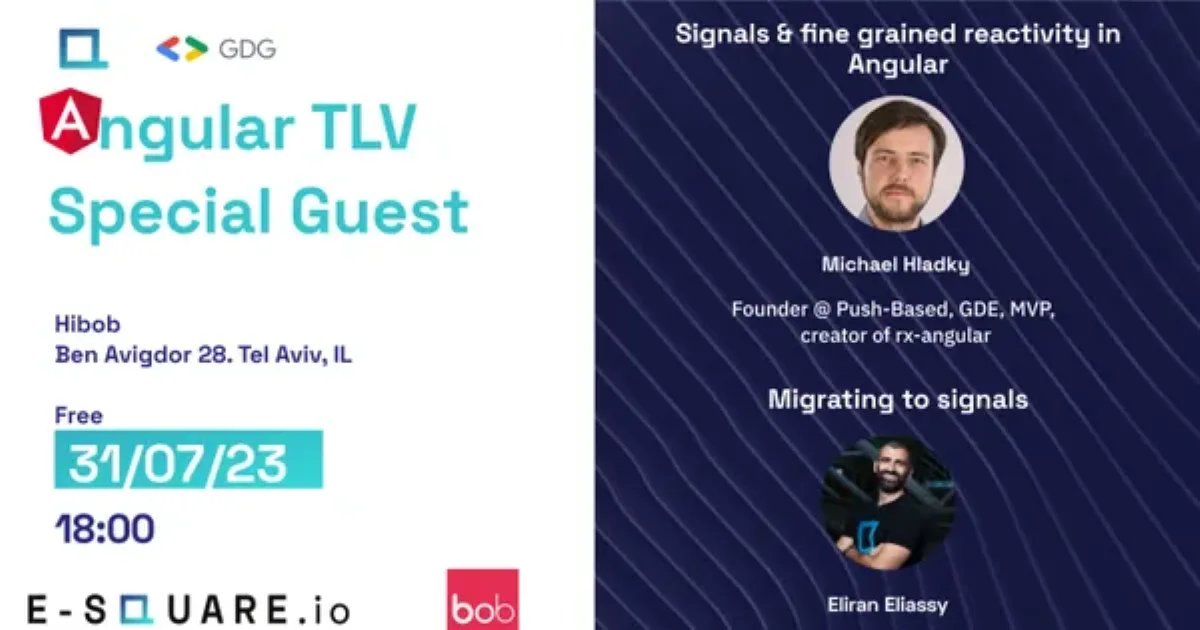
__19:00 - 19:30: Signals * fine-grained reactivity in Angular
Michael Hladky, Founder @ PushBased, Angular Google Developer Expert (GDE), Microsoft MVP, Creator of rx-angular.__
On Angular's roadmap is one item that is most probably the biggest change to the framework ever done. "Making zone.js optional".
As part of this effort they are revisiting Angular's reactivity model and will introduce a new reactive primitive to handle change detection. It will improve bundle size, runtime performance and more.
I will use the early PoC of Angular to demonstrate how a simple reactive primitive could get integrated in the framework and used to create reactive components.
That said, this talk will demonstrate you fine grained reactivity and zone less applications in a new flavor. It demonstrates modern Angular applications at the cutting edge.
Takeaways
Simplify reactivity
Improve debugging
Reduce application bundle size
Change detection strategies with or without zone.js
More from the speaker

Advanced CPU Profiling in Node - Profile Data Structure
CPU profiles are more than flame charts—they’re structured JSON files. Learn how nodes, samples, and time deltas form the backbone of DevTools performance data.

Advanced CPU Profiling in Node - Real-Life Examples
Profiling is easiest when it's real. Learn how to capture and make sense of CPU profiles in Node.js across scripts, threads, and processes—then apply it to your own projects.

Advanced CPU Profiling in Node - Best Practices and Pitfalls
Get deeper insights into your Node.JS performance. Learn how to master advanced CPU profiling with built-in tools, interpret process/thread IDs, and optimize using sampling intervals. Troubleshooting and real examples included.

Implementing Incremental Hydration in Angular (Part 3/3)
Implement incremental hydration in a real-world Angular app - Basic setup, hydration triggers and important considerations for a seamless integration.

The Game-Changing Impact of Incremental Hydration in Angular (Part 2/3)
Let's dive deeper into why incremental hydration in Angular matters so much for performance and user experience, focusing on its influence on Largest Contentful Paint (LCP), Interaction to Next Paint (INP), and Cumulative Layout Shift (CLS).

Incremental Hydration in Angular: Introduction (Part 1/3)
Incremental hydration is a groundbreaking new feature in Angular that heavily impacts critical performance metrics like INP and LCP, while also reducing the effort required to maintain CLS at low levels.